Women's Business Dress Code: What to Wear to Work (Tips, Examples & Designer Picks)
There's a specific kind of panic that hits when you walk into a room and realise you've read the dress code completely wrong.
Maybe you showed up in a blazer and tailored trousers to what turned out to be a jeans-and-loafers kind of office. Or the opposite — you dressed casually for a client meeting and spent the entire day feeling like you were at the wrong party. Either way, it's uncomfortable. And it's far more common than people admit.
The truth is, "business dress code" is one of the most misused phrases in professional life. Companies hand out dress codes like they're self-explanatory, but the gap between "business casual" and "business professional" is wide enough to drive a whole wardrobe through. And no one really teaches you the difference.
So let's fix that.
This guide covers everything you actually need to know about women's business dress code — what each level means, which pieces do the heavy lifting, how to use colour strategically, and how to dress like someone who has always known exactly what she's doing.
First, Why Does Getting This Right Actually Matter?
Follow the dress code of the workplace and the occasion you are attending. Clothing can meet a setting’s expectations without serving as evidence of someone’s competence, authority or professional ability.
That's not an argument for conformity. It's an argument for intention. When you understand what a dress code is actually asking of you, you can meet it on your own terms — with your own style, your own personality, your own aesthetic — without accidentally undermining yourself.
Once you know the rules, you can dress within them beautifully.
The Two Dress Codes That Matter Most: What They're Actually Asking
Business Casual: Polished, Not Precious
Business casual is probably the most misunderstood dress code in existence. People hear "casual" and immediately think relaxed — but casual here doesn't mean comfortable in the way a Saturday morning feels comfortable. It means the formality dial has been turned down from "full suit" to "put-together without the suit."
In practice, business casual for women typically includes tailored trousers or chinos, knee-length skirts, blouses, knit tops that aren't too relaxed, structured flats or low heels, and yes — in some workplaces — well-fitted, clean-cut dark jeans styled with a blazer and heels. What it doesn't include is anything wrinkled, anything that reads as weekend wear, or anything that looks like you grabbed it on the way out the door.
The key with business casual is intentionality. An outfit that's been considered and coordinated will always read as more professional than one that technically hits the dress code but looks thrown together.
Business Professional: The Standard That Has No Room for Guesswork
Business professional — sometimes called business formal — is the conservative end of the spectrum, and it applies more rigidly than most people expect. If you work in law, finance, consulting, or executive leadership, or if you're heading into a high-stakes interview or a client presentation, this is the code you're dressing to.
At this level, the expectation is structure and restraint. That means darker, core colours (black, navy, charcoal, deep grey), covered shoulders, skirts and dresses that land at or below the knee, and silhouettes that are tailored rather than relaxed. A suit remains the gold standard, but a well-chosen power dress or a blazer with tailored trousers achieves the same effect. The goal isn't to look stiff — it's to look like someone who has made a deliberate choice, every single day.
One simple benchmark: look at the most well-dressed person at your professional level in your workplace. Not the most stylish — the most well-dressed. That's your reference point.
The Pieces That Anchor a Professional Wardrobe
The Work Dress: The Easiest Professional Outfit You'll Ever Put On
There is a reason experienced professionals keep at least two or three exceptional work dresses in rotation: a great work dress is the full outfit. No building required, no balancing of proportions between top and bottom, no decision fatigue at 7am. You pull it on, you add shoes, and you're done — and you look like you put considerably more thought into it than you did.
For business professional settings, the dress needs to work harder. It should be structured, lined, knee-length or just below, and free of anything too casual — no t-shirt fabrics, no overly relaxed shapes, nothing that softens so much it starts to look like daywear.

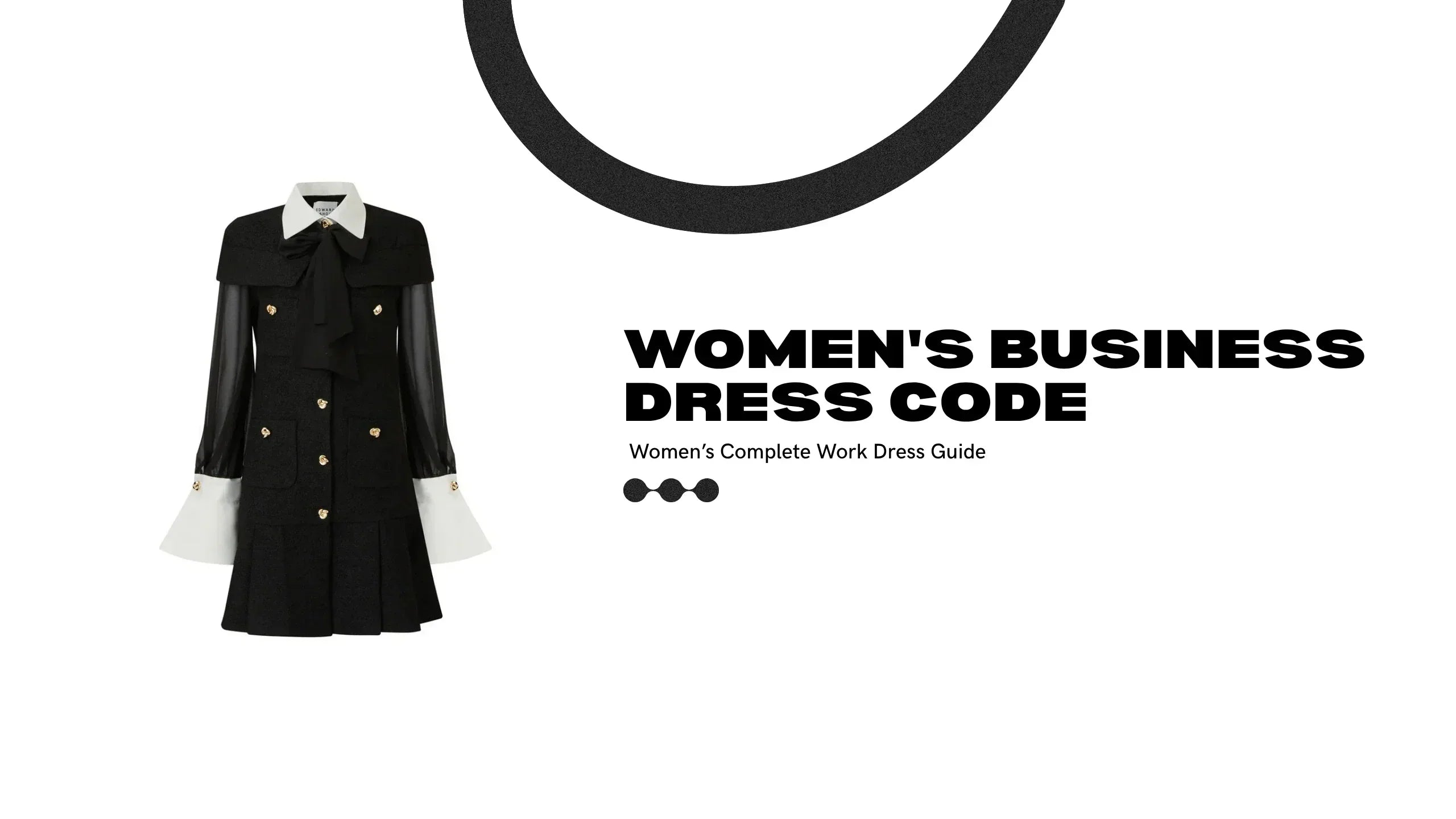
This is exactly where a dress like the Black Pleated Dress with Contrast Collar & Cuffs by Edward Achour Paris earns its place. Designed in Paris with the kind of precision tailoring the house is known for, it has a contrast collar and bow-tie neckline that immediately reads as intentional and polished, a softly pleated A-line skirt that falls at the knee, and sheer long sleeves finished with statement cuffs and gold-tone buttons. It's all black — which means it works with virtually everything — but the contrast detailing and the couture-inspired finishes mean it never reads as plain. This is a dress that looks considered, because it is. For a business meeting, a corporate lunch, or a formal presentation, it does everything a great work dress should do.
The Blazer: The Piece That Does More Work Than Any Other
A blazer is not optional in a professional wardrobe. It's the item that shifts an entire look up a register — that takes a pair of trousers and a blouse from business casual to business professional, or that gives a simple dress a sharper, more commanding edge.
What most women get wrong about blazers is settling for one that doesn't actually fit. A blazer that pulls across the shoulders, or that hangs straight rather than following the shape of the body, undermines the whole point of wearing one. Structure is the entire value proposition of a blazer — it needs to be fitted, with defined shoulders and a silhouette that works with your frame.

The Dark Indigo Cut-Out Belted Blazer by Edward Achour is a good example of what happens when a blazer is designed with real intention. It has structured shoulders, notched lapels, and an integrated belt with an adjustable gold-tone buckle that cinches at the waist to create a genuinely sculpted silhouette. The architectural cut-out detailing at the waist is the kind of detail that stops it from looking like every other blazer in the room — it's distinctive without being distracting. The dark indigo denim-look fabrication keeps it grounded and professional. Style it over tailored trousers for a business professional look, or pair it with slim pants and pointed-toe heels for a polished business casual outfit that still has real presence.
The Tailored Trouser: The Base That Makes Everything Work
If there's one piece that forms the foundation of more professional outfits than any other, it's a well-fitting pair of tailored trousers. Classic black, well-cut, hemmed correctly — they are the professional equivalent of a blank canvas. Add a formal blouse and a blazer and you're business professional. Remove the blazer and swap the heels for loafers and you're business casual. Same trousers. Entirely different register.
High-waisted cuts deserve a specific mention here: they elongate the silhouette, create a clean and intentional line, and have an effortlessly polished quality that sits perfectly within both dress codes. The only real rule is fit. Trousers that pool at the ankle, pull across the hip, or are too baggy through the leg are doing none of the things a good trouser should do.
Shoes: The Detail That Changes the Entire Outcome
This one surprises people until they try it. The exact same outfit — blazer, trousers, blouse — reads differently depending entirely on the shoes. Swap a pointed-toe heel for a clean leather sneaker and the formality drops immediately. Put a dressy flat on in place of a stiletto and something shifts. Shoes are the most efficient tool for calibrating where exactly on the dress code spectrum you land on any given day.
For business professional settings, go with heels, structured flats, or dressy mules in neutral or deep tones — black, nude, deep burgundy, navy. For business casual, you have more flexibility: loafers, block heels, and even clean, minimal leather trainers work depending on your industry. The constant across both is this: scuff-free, intentional, and cared for. Shoes that look neglected undercut everything above them.
How to Use Colour Without Getting It Wrong
One of the most consistent mistakes in professional dressing is treating colour like an afterthought, or worse, avoiding it entirely out of a fear of looking unprofessional. You don't need to dress in black and grey every day of your working life — but you do need a strategy.
The most reliable approach is to build your core wardrobe pieces — trousers, blazers, dresses, skirts — in what stylists call core neutrals: black, white, navy, charcoal, and camel. These are the pieces that work with everything, the pieces you reach for without thinking. Then let your personality come through in the details: a deep jewel-toned shoe, an interesting structured belt, a bag in a colour that makes you feel like yourself.

Dark indigo is a particularly good example of a colour that straddles the line between neutral and statement. It reads as professional and polished without disappearing into the background the way black sometimes can. In a well-structured blazer, it's an excellent choice for business professional settings — it has authority, but it also has character.
The rule to remember: let the structure and fit carry the professionalism. Colour is where you get to be a person.
What Professional Dressing Doesn't Have to Mean
Here is the thing that gets lost in most conversations about women's business dress code: professional doesn't mean boring. It doesn't mean identical. It doesn't mean suppressing everything that makes your style yours.
Look at what the best-dressed women in any executive environment actually wear. It's rarely a plain grey suit in the same cut as everyone else's. It's a suit in an unexpected fabric, or with an oversized lapel that's very of-the-moment. It's a monochrome look with a sleeve that has a barely-there puffed detail. It's a classic silhouette finished with a shoe that has just enough personality to make the whole thing feel alive.
The details are where professional dressing gets interesting. A contrast collar. A sculptural cut-out at the waist. Gold-tone buttons on a cuff. These are the things that make a professional outfit feel like it belongs to someone specific — not just to "a professional woman."
That's the real goal: to look like you dressed with intention, and for that intention to be entirely, unmistakably yours.
Building a Wardrobe That Works Across Both Dress Codes
The most practical approach to professional dressing isn't to build two separate wardrobes — one for business casual days, one for business professional. It's to invest in pieces that can shift between both depending on how they're styled.
A structured blazer worn with jeans and heels is business casual. The same blazer over tailored trousers with a polished blouse is business professional. A work dress that falls at the knee can feel business casual with loafers and minimal accessories; add a structured bag and a low heel and it reads immediately more formal.
This is where investment pieces earn their keep. A great blazer, an exceptional work dress, a perfectly fitted trouser — these don't just serve you once, they serve you across years and across contexts. They're the pieces you reach for without thinking because you know they'll work.
If you're building or refining your professional wardrobe right now, start with structure. One or two pieces with real tailoring, exceptional finishes, and a silhouette that holds its shape — that's the foundation everything else builds from. Browse the full structured work dresses collection at BTK Collections for pieces that are designed exactly with this in mind.
Shop the products featured in this post: